

Paper markets
Goldmoney estimates there are roughly 180,000 tonnes of gold above ground, much of which cannot be categorised as monetary: monetary not as defined for the purposes of customs reporting, but in the wider sense to include all bars, coins and pure gold jewellery accumulated for its long-term wealth benefits through good and bad times. Annual mine production adds 3,000-3,500 tonnes, giving a stock to flow ratio of over 50 times. Put another way, the annual increase in the gold quantity is similar to the growth in the world’s population, imparting great stability as a medium of exchange.
These qualities stand in contrast to the increasingly certain acceleration of fiat currency debasement over the next few years. Anyone prepared to stand back from the financial coalface can easily see where the relationship between gold and fiat currencies is going. Most of the world’s population is moving away from the established fiat regime towards gold as a store of value, their own fiat currencies lacking sufficient credibility to act as a dollar alternative. And financial markets immersed in the fiat regime have very little physical gold in possession. Instead, where it is now perceived that there is a risk of missing out on a rise in the gold price, investors have begun accumulating in greater quantities the paper alternatives to physical gold: ETFs, futures, options, forward contracts and mining shares.

Paper markets
From the US Government’s point of view, gold as a rival to the dollar must be quashed, and the primary purpose of futures options and forwards is to expand artificial supply to keep the price from rising. In a wider context, the ability to print synthetic commodities out of thin air is a means of suppressing prices generally and we must not be distracted by claims that derivatives improve liquidity: they only improve liquidity at lower prices.
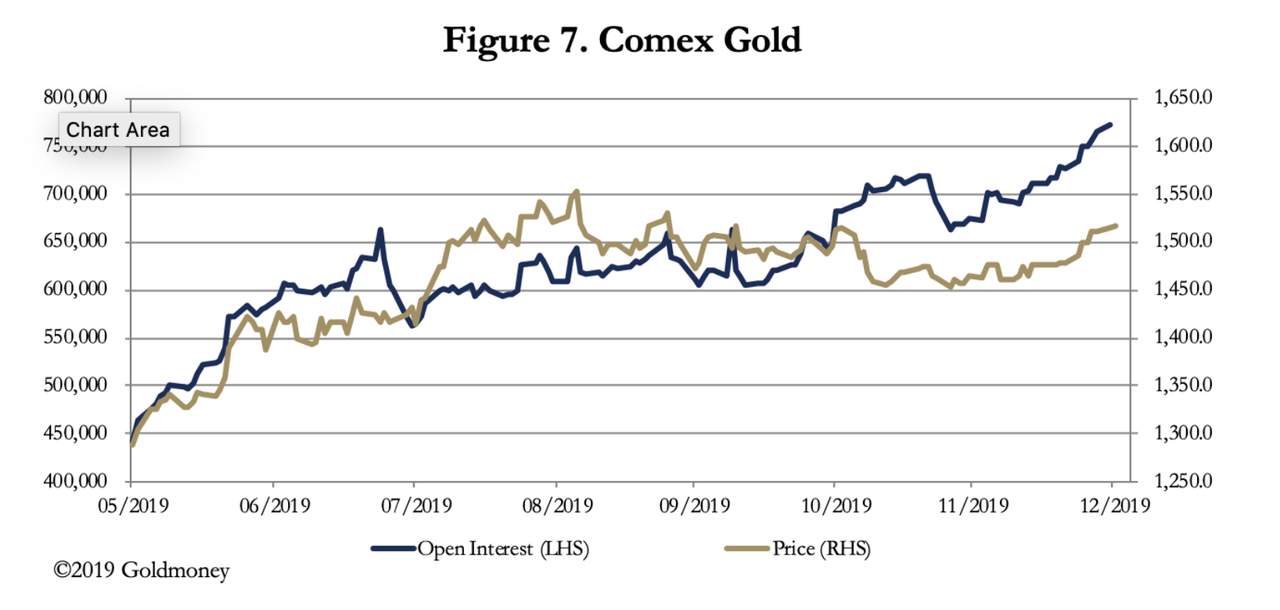
When the dollar price of gold found a major turning point on 17 December 2015, open interest on Comex stood at 393,000 contacts. The year-end figure today is nearly double that at 786,422 contracts, representing an increase of paper supply equivalent to 1,224 tonnes. But that is not all. Not only are there other regulated derivative exchanges with gold contracts, but also there are unregulated over the counter markets. According to the Bank for International Settlements from end-2015 unregulated OTC contracts (principally London forward contracts) expanded by the equivalent of 2,450 tonnes by last June, taken at contemporary prices. And we must not forget the unknown quantity of bank liabilities to customers’ unallocated accounts which probably involve an additional few thousand tonnes.
In recent months, the paper suppression regime has stepped up a gear, evidenced by Comex’s open interest rising. This is illustrated in Figure 7.
Paper markets
 Reviewed by romania
on
tháng 1 05, 2020
Rating:
Reviewed by romania
on
tháng 1 05, 2020
Rating:
Reviewed by romania
on
tháng 1 05, 2020
Rating:


Không có nhận xét nào